Showing posts with label mental health. Show all posts

Thursday, 9 August 2018

Put Your Action Where Your Mind Is

Reading time: 6 minutes
Summary: This post is about the things we know are good for our mental health, but that we don't always make an effort to do; it can hopefully encourage you to find ways to do the things that you know are helpful for you. 

Last week I read Brené Brown's "The Gifts of Imperfection: Let Go of Who You Think You're Supposed to Be and Embrace Who You Are. Your Guide to a Wholehearted Life." I admit I cringed when I saw the cheesy cover combined with the cheesy title, BUT the author is Brené Brown, and she has gained both my respect and my interest by her overall approach to mental health. Brené and I seem to share a task-oriented stubborn determination to plough through life, achieving whatever strikes our fancy (and ideally doing so faster and better than everyone else. '...Life is a competitive race, right?' No? Just me..? Ok.) You can get a sense of her research on shame, courage, vulnerability, and wholehearted living, as well as her approach to mental health more generally, by watching her tedtalk. (It's one of my favourites.)

There are many parts of Brené's book which I found striking and helpful, but I'm going to summarize just a few of them here. I should note that, while I've picked up on these from reading her book, there are so many other influences in my life lately that make me hone in on these particular things. Other big influences have been the PhD I'm doing at the University of Cambridge with a supervisor who values and encourages deep learning, attending meditation retreats with Jaya Ashmore, reading poetry (I really love the works of Mary Oliver, Rainer Maria Rilke, Nayyirah Waheed, William Stafford, and Wendell Berry), reading books or listening to podcasts by theologians/philosophers/individuals who grapple with questions of faith and what it means to be human (Paul Knitter, Swami Prabhavananda, Ram Dass, Pema Chödrön, and The Liturgists podcast), as well as having an abundance of conversations with dear friends and colleagues. I'm so grateful for each of these influences. 

Alright, back to some insights gleaned from reading Brené Brown's book. 

1. If we pay attention to our bodies, we can note physical symptoms of anxiety, stress, freak-outs, etc. Recognizing the physical symptoms can "cue us" to respond healthily. 
If you are like me, you might not 'listen to your body' all that often. (This is coming from the girl who rarely takes sick days, who has played basketball with a broken wrist & jumped on a trampoline with a broken ankle---to name a few.) Let's say, for example, you open up an email from someone that says something critical of you, or that for another reason you find troublesome. If you were to notice that your palms are sweating, or that you have a headache, or that your chest feels tight, or that you've just clenched all the muscles in your neck, it might be a good moment to pause, take a deep breath (or a nap) or even wait an entire day before replying. This can be true on much bigger scales, as well.

2. "If we want to live a wholehearted life, we have to become intentional about cultivating sleep and play, and about letting go of exhaustion as a status symbol and productivity as self-worth."
I find that this is especially true of graduate students or early career individuals, or anyone who is still trying to "prove themselves." Sometimes we don't even realize it, but phrases like "I was at the library 12 hours yesterday", or even just feeling exhausted and taking that as indicative of working hard---AND SOMEHOW FEELING PROUD ABOUT IT!?!?!---is very very damaging to our mental (and physical) health! Research by Lynne Twist also shows that we increasingly feel like we have to be busy and productive in order to be good, admirable people. That's kind of messed up.. Sleep and play are both important. Make time for them.

3. There is not only a big difference between the things we achieve and the things that make us joyful but the things that we are trying to achieve do not always allow for the things that make us joyful.
Brown suggests to make a list of the things you are doing when you feel joyful, and to place that side by side with a list of things that you are actively and intentionally trying to achieve. Do they line up? Do the things on the latter list actually allow for / encourage the things on the former? I tried it, and on the "achievement" list I had things like "publish a peer reviewed article", "get a tenure track teaching job." On the "joyful" list I had things like "garden," "play music with friends," "cook and eat good food." Some of the desired achievements did allow space for the things that make me joyful, but many did not---and this certainly made me wonder whether I have my priories straight! (Consider asking yourself the question: 'Why am I spending all this time and energy trying to achieve goals that do not give me nearly as as much joy as the things that I already have within my grasp?' I'm certain there are ways to intentionally focus more on the things that give us joy...)


This leads us to the next and last one:
4. There is a difference between theoretically agreeing with something, and acting upon it. So often, we become theoretical advocates for things that improve mental health, but we rarely follow through ourselves.
Reflecting upon this made me come up with the phrase "put your action where your mind is" (from 'put your money where your mouth is'). There are so many things that I advocate for and/or theoretically agree are valuable, but it is rare for me to prioritize them into my busy schedule. I love lists, so of course I made a list of these, too. For me, they included: spiritual practice, community and relationships, reading, exercise, tidiness, deep rest and relaxation, intentional creativity (art, music, writing), being outside. But, when I look at how I spend my time, it is mostly: PhD reading/writing, other academic side projects, applying for future academic projects, scarfing down food, going to the gym simply to check off 'exercise' from my to do list, and Netflix. (Of course, I sometimes do make some time for the other things, but they are rarely a priority. I'm not proud of it, but if I feel short on time, it is always the "extra mental health stuff" that is the first to get cut from my daily rhythm.) 

I wonder what might life look like if we didn't view those 'good for mental health things' as extras, that could be fit in if and when we finished all the 'real' stuff? What if, instead, we were to recognize them as important pillars for the rest of life? For one, I suspect that our self-worth, our relationships with others, and even our work ethic/creativity output would all improve...


Monday, 30 October 2017

Grad School + Beyond:

I'm 3 years into my PhD and I just read the statistic: "only three or four in every hundred PhD students in the United Kingdom will land a permanent staff position at a university."
The stat showed up in this article in Nature's International Weekly Journal of Science, which is written with regard to the sciences, but I have my severe doubts that the humanities are any better off: the reality is that myself and most graduate students I know will be hard-pressed to get a permanent contract with a university even after we've all become "Doctor ____."
This should cause us to pause and reflect on why we're doing these degrees in the first place.
To me, graduate studies---isolated yet competitive work culture, high-stress, long hours, low-pay, and seemingly with no promise of an academic job that most people assume they will fall into---is really only worth it if you (a) can work with the flexible learning environment it allows (/forces upon) you; and (b) can stay happy/healthy while doing it.
An alarmingly high number of students struggle to stay happy and healthy + link this struggle to their studies/work environment. Some studies like this one in Science have shown that 1 in 3 graduate students struggle with mental health on account of their workload and work environment (and, based on my friend/colleague circle, I'd speculate it's actually significantly higher than 33%.)
I assume I will be happy to have done my PhD even if I wind up in a career totally outside of academia where my PhD specifics aren't really needed (/useful?) (--but then again, I only pursued graduate studies in the first place because it provided a debt-free, albeit financially meagre, way to do full-time learning on topics that interest me.) I truly hope that other grad students feel similarly, and that they're studying their various research topics primarily because they enjoy the process of studying. (At least, I pity those of you who are wading through grad school, not enjoying it at all, but are under the [false?] hope that you will end up in a TT professorship job.)
So, if this is indeed true that the process itself ought to be enjoyable, it is most important that we focus on enjoying the actual process at hand.
A few things come to mind in this regard. I'm writing them out somewhat with the hope that I will force myself to adopt them for myself...(that is, they are pieces of advice which are thus far hypocritical due to not following them myself...)
1. Abandon the 'publish or perish' paradigm. 2. Stop stressing that I haven't read enough theories, or don't know as much of the literature as xyz. 3. Focus on learning for the sake of improving my knowledge of a topic that interests/intrigues me---not for appearing smart, not for impressing my supervisor, etc. 4. Don't try to make a perfect + brilliant thesis/paper/etc. That benchmark is unrealistic and can be somewhat uninspiring. Try to write something that is interesting, or challenging, or inspiring, or beautiful, ...and coherent. It doesn't have to incorporate everything you've learned and it doesn't have to be applauded by the academe. 5. (I would like your tips/feedback!) And, now, a poem...which I find challenging, inspiring, beautiful, and coherent.
"Every day I see or hear something that more or less
kills me with delight, that leaves me like a needle
in the haystack of light. It was what I was born for - to look, to listen, to lose myself inside this soft world - to instruct myself over and over in joy, and acclamation."
~ Mary Oliver (USA, 1935-), from “Mindful,” Why I Wake Early


Sunday, 1 January 2017

Why 2016 Wasn't The #WorstYearEver

2016 was difficult but it was also good. Some shitty, horrible, heart-breaking things happened but it was not the infamous "#worstyearever." 

I've learned a lot about myself as an individual (and a small amount about executing self-care), a lot about what it means to exist relationally/ with intentionality, and a lot about what I value in myself and others, who I want to surround myself with, and who I want to strive to become.

I think our broader communities and societies have learned a lot about what it means to fight for justice, to give voice to the oppressed and to show our support, to protect what is sacred, to stand up against what we believe to be wrong, to amplify love in the midst of hate, to choose to live vulnerably and to admit our brokenness to each other even when it’s tempting to appear like we’re self-sufficient and totally fine, to act selflessly and care for those who are in need, to persevere when things look rough, and to find ways to make positive changes even when they are small and may seem insignificant. This year had bad things (all years do) but it also had loads of good come from it. And I think history has shown that times of significant difficulty open us up to being more loving than we were before; we are often not challenged to step up when we are in our comfort zone. A ‘the stars shine best in the darkness’ sort of thing. 

So, yes, I am welcoming 2017 with open arms: the liminal space offered by the change of calendar years provides us with a sort of clean slate, and with new energy. We can use this to become better versions of ourselves and to work together to create better (move loving, more inclusive, less selfish) communities. But I’m not running away from 2016 as if I want nothing to do with it, or as if I want to pretend it didn’t leave a mark on me. It did. It has shaped me. It was not always sunshine and rainbows, and yet I have reason to smile. (Wouldn't you say the same?)


Least I seem overly-optimistic, let me reveal my stoic/realist-tendencies via this photo.


Also: not totally related, but I am really appreciating this excerpt from Seneca's letters. 
Let's not fear what we don't need to.


"There are more things, Lucilius, likely to frighten us than there are to crush us; we suffer more often in imagination than in reality. [...] What I advise you to do is, not to be unhappy before the crisis comes; since it may be that the dangers before which you paled as if they were threatening you, will never come upon you; they certainly have not yet come. Accordingly, some things torment us more than they ought; some torment us before they ought; and some torment us when they ought not to torment us at all. We are in the habit of exaggerating, or imagining, or anticipating, sorrow.

[...] Do me the favour, when men surround you and try to talk you into believing that you are unhappy, to consider not what you hear but what you yourself feel, and to take counsel with your feelings and question yourself independently, because you know your own affairs better than anyone else does.


[...] It is likely that some troubles will befall us; but it is not a present fact. How often has the unexpected happened! How often has the expected never come to pass!

[...]The mind at times fashions for itself false shapes of evil when there are no signs that point to any evil; it twists into the worst construction some word of doubtful meaning; or it fancies some personal grudge to be more serious than it really is[...]. But life is not worth living, and there is no limit to our sorrows, if we indulge our fears to the greatest possible extent[...]There is nothing so certain among these objects of fear that it is not more certain still that things we dread sink into nothing[...]."


Sunday, 25 December 2016

"Peace on Earth" etc. etc.

Merry Christmas! I am thrilled and grateful to be with my siblings and parents for Christmas, as well as with a number of friends-who-feel-like-family in the days surrounding the holiday. I'm enjoying it quite a bit :)! 


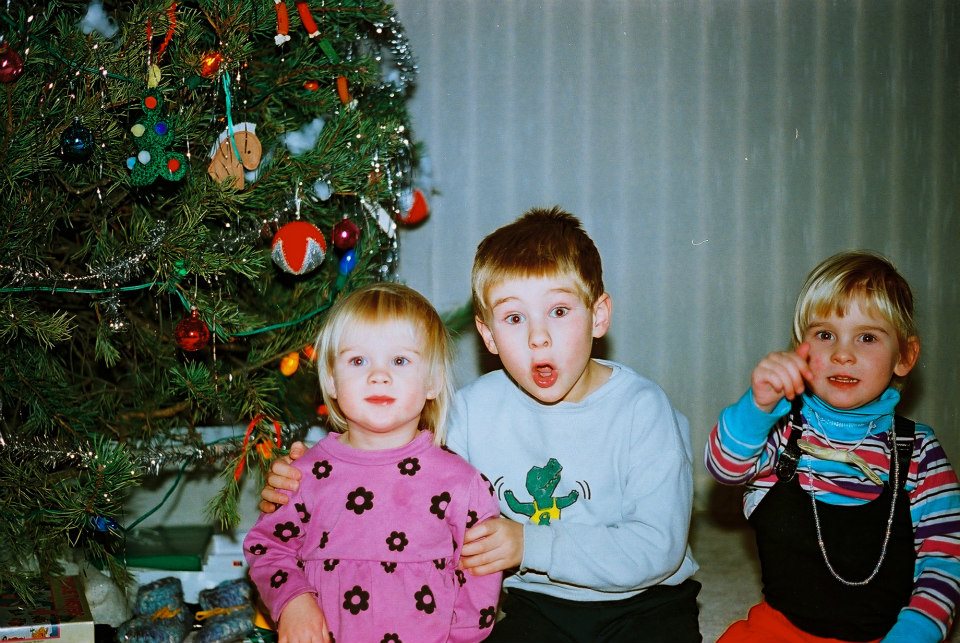
About 25 years later, my siblings and I still indulge in
silly laughter around my parents' Christmas tree.


But I also know that holidays, more than the average day, can place a megaphone to the pain in our lives. Maybe it's the first Christmas without a particular loved one. Maybe you aren't with family or friends or other loved ones. Maybe gift buying has made you broke. Maybe you feel lonely, or wistful, or apprehensive, or sad, or empty, or confused about what is really important.

I find myself in some of these spaces.

I think these pains are legitimate and so are the questions evoked by them. This is my advice--to all of us who have moments (or extended moments) of hardship in the holidays: try to glean what good stuff you can from this opportunity for such reflection. Try to use it as a time to explore yourself deeper and know yourself better. Try to look at the most frightened, puffy-eyed part of you and tell yourself 'you are loved, and you are going to be okay.' Try to walk forward--not running away without ever looking back, but walking steadily with your eyes fixed on where you want to be, yet comfortable to glance around and look your past square in the eye. It's an important part of you, and whatever you've walked through is what allowed you to get here. Try to continually reorient yourself so that you are simultaneously wrapped up in love, supported by love, and are walking toward love. Try to let your heart and hands be loosed of any unnecessary things you've been carrying; it's easier to walk forward without them. Try to ask someone else for a hug, or a listening ear, or a walk, or a sleigh ride if/when you need it. It's okay to need it.

my sister took this in Cypress


There's a beautiful Christian tradition in some churches to physically "pass" the peace of Christ from one person to the next. I've partaken in this whilst in a Syrian Orthodox Church in India: one person starts with the intangible "peace" held symbolically in his hands and, as he passes it to 2+ people, it gradually makes its way through the congregation. It's a beautiful way of enacting the symbol of spreading peace on earth. And this--the celebration of a birth of a baby who people believed would bring peace on earth--is a worthwhile Christmas reminder. It may be about giving/receiving gifts, it may be about spending time with family+friends (both of these can be done in healthy or unhealthy ways, I think), but it's also about peace. And that encapsulates a whole lot of things. I hope you partake in peace this Christmas

Tuesday, 18 October 2016

Processing Sufferings and Creating Joy, Peace, and Love


Recently I left my "jungle ashram" and went with a lady who used to be affiliated with the ashram as its manager.


Evening service at the ashram
She invited me to go to Faridpur with her and to join her in some outreach project which happened in nearby villages., and I thought doing so would offer an interesting perspective. So we went.


For the most part, we were going to villages and talking about sanitary pads and menstruation and feminine hygiene.


A group of about 40 women (aged 17-35) gathered to learn about sanitary pads

I also sat in on some sewing classes for village girls, learned some stuff about village agricultural farming, and I saw the local hospital and how things are done there. It was an enlightening experience all around. I'm so very glad I went :).
Piles of black peppercorn being left out to dry before selling


Two village women cutting rice crops


But also at the hospital I saw a woman who died shortly after she left our premises. And because I'm this delicate mix of being simultaneously overly-sensitive and strangely-stoic, I now have all these feelings that I've been shoving down my throat and keeping them unprocessed.

I suppose I thought writing this out might help me process them; thanks for reading my processings.

She was a young girl, newly married, probably in her early twenties. She arrived at our hospital being carried in like a sack of potatoes because she was totally immobile; her pulse was 150 beats per minute, which is outrageously high. We gradually learned she had consumed poison, though her husband (the one carrying her) was not very helpful in giving such information upfront. She was mostly unresponsive; the poison having already gotten to her brain.

As time went on, and as I listened to the doctors and staff discuss, it became clear to me that there was a good chance her mother in law had poisoned her. Either that or she had drank the poison herself because she no longer wanted to live this life. Locals said it was probably kerosene that she consumed, or maybe some kind of pesticide. The doctors weren't sure.


Some of the girls from surrounding villages who came to take sewing classes
offered by the mission hospital's outreach programs.

Our tiny mission hospital didn't have the facilities for her so we had to refer her out, to a town hospital which had a poison specialist (because such things are so common here.) The husband loaded her onto a motorbike that our hospital had on hand, he sat behind her, and our driver sat at the front. The woman was plopped onto the bike, sandwiched between them, and her husband held her body to keep it upright as they drove off.

She died en route; we were notified of this later that evening.


In the days that followed (and even the days leading up to it, in a sort of eerily strange foreshadowing) I heard a number of stories about young women--especially newly married wives--who either killed themselves or who were killed by their husbands or mother in laws. The reasons for murder ranged: she wasn't pretty enough, she wasn't working hard enough, she didn't get pregnant fast enough, the dowry wasn't big enough...etc. The reasons for suicide were similiar: afterall, it is difficult to find value, beauty, or joy in life when these are the kinds of things being told to you about yourself.

I do not know how to process the reality of a world in which one individual decides that such reasons are enough to poison someone, or to douse them in kerosene and then burn them to death.

How can this world be the same one that I live in? How can my reality be so different than the realities of others? How can this be the world we live in?


I wonder if I could find any reason to live if that were my life. I'm not sure that I could. I'd like to think that I'd change my scenario--I'd leave my husband, or I'd leave my in-laws........but what if I had no where else to go? What if I had no other options? What if even my parents didn't want me to return, or perhaps never even wanted me to be born in the first place since I'm a village girl and would only be a financial burden to them? What if the thought of taking care of myself and prioritising my own needs/wants never even crossed my mind?

......For my own part (and I realise that my perspective is limited), I feel that the subconscious minds of many village girls are trained from a young age to never even contemplate such thoughts. Certainly not all..but it seems that many are.


I don't even know her name. I'm not sure our mission hospital even recorded it; I think we discharged her without a record that she even came--we hadn't bothered registering her as her husband carried her in because we rushed her to our unused hospital ward where she could lay down on a bed as the doctor monitored her. We still don't know if it was a murder or a suicide; but since she is so newly married the police will likely investigate it as if it were a murder.

And, in all my bewilderment and sadness/confusion, I find myself wondering if she ever regretted having consumed poison or if she ever wished she hadn't. I don't know if, in even those final moments of life, she felt convinced that it would be better to be dead than be alive. I don't know.


I don't know that I know how to provoke any positive change in this particular phenomenon. I wouldn't even know where to start. I feel so overwhelmed and helpless and hopeless sometimes. But what I know is this: we all need to strive to transform our world into one in which all individuals experience joy, peace, and love. And I think we can, we must, each do this--- at least on some micro-level! That is all I know.


Today, may you experience joy, peace, and love. 
And may you share it with others.

(As always, feel free to comment below or to PM me. I would really love to hear from you.)

Wednesday, 3 August 2016

Goals and Prioritising + and Living Meaningfully

What are your goals for this next 12 months? (Is that a question you ever ask yourself?)

It’s a question I ask myself a lot—in various forms/time-lines. In fact, I am willing to entertain the possibility that I just may be too Type-A/task-driven ;).   I make goals for what I want to do on that particular day (or in that particular 50-minute period) and I usually also have a ~7 day, ~3 month, ~12 month, and ~3 year list of to-dos/goals either pinned to my bulletin board or just floating around somewhere in my mind. I feel immensely more calm when I have some sort of plan—preferably written out in a spreadsheet with colour-coding and hyperlinks J. I really like having a sense of where I might head, even if past experience has shown me that that almost always changes.

Now, I’m about to go to India for approximately one year of fieldwork (focused on interreligious relations and based at an ashram.) And, now knowing this ^ about my goal-orientedness, you can appreciate my feelings of chaos when the ashram estate manager informed me “you can come and stay for 2-3 months, but after that let’s see.” I felt like I was treading water and a big wave splashed me in the face; I gasped and choked a little bit.

At present, I plan to be in India for ~11 months. How was I to cope with this “stay for 2-3 months and then we’ll see”? If I wasn’t going to remain at that place, I wanted to at least write down on a piece of colour-coded paper where I thought I’d be for the remaining months.

And so, my type-A brain is doing the next-best thing. I am planning not WHERE I want to be for the next 12 months, but WHO I want to be. Another way of conceptualising this has been: what do I want to get out of the next 12 months? Yet another way has been: what do I want to focus my energy on and contribute to during the next 12 months?


Who do you want to be (or, perhaps, to become) in the next 12 months? (Is that a question you ever ask yourself?)


I continue to ask these sorts of questions while preparing to head to India because, over my multiple trips to India in the past ~4 years, India has become a place where I have allowed myself to explore these questions in a very real way. Of course, I pose them in other places too, but I seem to pose them especially whilst out of my "regular" routine--and a lot of this has happened to be in India.

Evening aarti on the Ganges river in Varanasi


I think these are important questions to think through. (And so I’ve made a list and colour coded them.) Just kidding. Or am I?

Here are some of the things I want to spend my time doing. (And yes, I note they are still in the form of a to-do list. You can’t completely strip me of my organisational tendencies..)

- learn Hindi
- try to play an Indian classical instrument. Maybe the sarod.
- be happy
- be involved in the community I find myself in
- gather enough data to write a good PhD thesis
- don't become consumed by getting enough data to write a good PhD thesis
- sketch and draw
- meditate lots
- learn to record good audio (my own songs? Bhakti bhajans?)
- become better at video shooting and editing; make short videos about life in the ashram and life in india
- live simply and sustainably (maybe get involved with some community-kitchen projects, or agriculture)
- appreciate small things; say ‘thank you’ more often
- become less judgmental and more compassionate
- learn local ways of doing things (sewing? agriculture? cooking?) that I do not currently know
- learn what people outside of academia think about God/religion/interreligious relations
- practice communicating my thoughts on ^ for people inside and outside of academia
- spend time outdoors; go hiking
- write poetry
- find creative ways to enter [non-academic] discussions about what it means to live meaningfully
- learn more about who/what God is

Sunshine in Croatia


Of course I do realise that some of these are a bit more ambiguous than others are…

Broadly speaking, I find that, all too readily, I become stressed out about planning details and striving for goals that—in the grand scheme of things—don’t really matter all that much. For example, writing my PhD thesis: this is a good and admirable goal, and I intend to focus on content that I think is important for a number of reasons…but as soon as this particular goal takes over my ability to be a loving friend/family member, a kind neighbour, or a compassionate stranger, I think I have to seriously question whether I have my priorities straight.

This is difficult because, for the most part, we live in societies that are career/results-driven. At least in my experience, careers (and steps towards improving our careers) are the one thing that people are almost bound to congratulate others on.

I had a sort-of “aha!” moment in this regard when I was accepted for my PhD. Around the same time, a friend of mine (who is extremely intelligent and could certainly have gone on to do a PhD had she wanted to) decided to take a short-term contract position. At this same time, she also chose to put off any imminent plan of doing a PhD so that she and her husband could start their family without worrying about PhD stresses. People congratulated me on my PhD. And people congratulated her on her contract work. But a number of people asked her why she wasn’t doing a PhD, and I think very few (if any) congratulated her on her decision to devote her time and energy to her future-kids, to her marriage, and to all the other ways she was now able to volunteer within her community.  Why is this?

Why is it that we automatically congratulate and praise things associated with “measurable intelligence” and (presumably) pay-checks, but we rarely think to congratulate or praise people who have chosen to live in a way that leaves a small carbon footprint, or who grow their own vegetables, or who volunteer at the soup kitchen, or who do any number of other things that are inarguable examples of love for their community around them and/or for the world in which we live.

Rocks and rivers in Vancouver, Canada


Priorities change with opportunities, and this is inexorably wrapped up in priviledge. I recognise that, and I recognise that I'm not addressing that here. But, with the opportunities (and yes, the priviledges and Priviledge) that I have, I think I must seriously question whether I am using my time, energies, and passion well. Am I choosing to live in ways that grow me into a more loving and compassionate person? Am I choosing things that make me happy---and doing so in a way that does not abuse or hurt others--rather than choosing things that make me (in the eyes of some) "successful"? What might our world look like if we all strived to become more focused on love, compassion, and service to others rather than on success, prestige, and wealth? (I've written out some thoughts on a related topic here)

All this to say, I want to keep my priorities in check. And I want to be someone whose schedule and goals reflects their theoretical priorities. And I want to be someone who tries to praise and encourage others who engage in intentional acts of loving kindness. How about you, who/what do you want to be? As always, feel free to comment below or PM me. 

Sunday, 29 May 2016

Perfectionism, Vulnerability, and Reconsidering What It Means to Be Strong

I spend a lot of time thinking about what it means to be strong.

I suspect I appear strong to others, because it probably looks as if I have things going quite well for me and that I have a ‘good head on my shoulders’ or something like this. I have a great circle of caring & fun friends. I am doing my PhD on full scholarship at a top-ranked institution. I’ve always played sports at a high level. I create art and sometimes even perform it in public venues. I’ve been actively involved in a variety of student council type activities. I’ve been successful at getting teaching opportunities and jobs with leadership responsibilities, and I generally do well in these environments. I’m determined, hardworking, and organised, and I tend to get shit done (and usually in advance of deadlines!) and this is what many people see when they look at me. I can appear ‘strong’ to others, and sometimes I even trick myself.

But all of my close friends know another side of me as well. They know that I all too frequently struggle with really intense feelings of worthlessness and meaningless, and that I often find myself losing total hope and wanting to give up. My close friends know that I walk this weird, delicate balance where I desperately want people to love and accept me and near-constantly doubt that they do. It can be debilitating to always wonder if they do. My close friends know I want to be someone who doesn’t need anyone, all the while knowing that I’m someone who totally needs a loving, supporting community around me because human beings are built for relational connections, and I’ve grown to need this over the years. They know that I crack under pressure and can easily enter a full-on panic attack where I seemingly forget how to breathe; where I gasp for air, blubbering like a baby, until my body becomes so tired from shaking and hyperventilating that I finally shut down, and I just lay there for a while before stoically getting up and forcing myself to get shit done. Because I get shit done…that’s what strong people do, right?  

I try to limit these ‘weak’ moments like my anxiety or depression to the comfort of my own home but they’ve happened in spaces where I couldn’t bottle them in anymore; I regularly had panic attacks at the department building where I did my master’s degree. One time I collapsed on a walk home from school from hyperventilating after a particularly anxiety-ridden day.  I felt totally dejected the other morning at the library while printing an assignment because I began doubting whether I had anything worthwhile to say, or whether I should be in this PhD program. I frequently experience intensely negative thoughts that I am not good enough to be doing whatever it is I am trying to do. And I begin to feel weak. And then I feel weak for beginning to feel weak, because why not. ‘Weak people are lame! Get it together!!’ It can be a vicious cycle.

I spend a lot of time thinking about what it means to be strong.

One of the lookouts from the wall of the old city in Dubrovnik, Croatia

I’m extremely competitive, not just with other people but also with myself. Sometimes competitiveness and drive is good, and I have had some excellent improvements in my life from my desire to excel and improve, but I can also become a cruel, unkind person when totally driven by my desire to want to be the best at something no matter the cost. I try to reign this in and to re-orient my priorities, but there are so many societal pressures that instruct us, either explicitly or implicitly, to try to be the absolute best. This means different things for different people, but I suspect we all have some form of this being shoved into our faces and down our throats. It can be difficult to fight against these messages and pressures, and it can seem appealing and attractive to respond with fervor to them; to rise up and ‘be stronger’ or ‘better’ or whatever adjective applies to your own context. (Smarter...prettier...thinner…wealthier …etc.)

I spend a lot of time thinking about what it means to be strong.

Practicing the art of balance along an abandoned rock beach in Dubrovnik

I’m tempted to think of strength simply as perseverance—as the act of using the mental equivalent of pure brute force to press on and push through whatever difficulty might arise. I’m tempted to think of strength as ‘getting shit done’ even when you feel like lying in bed.

But, when I’m honest with myself, I submit that this sort of strength isn’t really strength at all but a means of maintaining the illusion of control so to appear strong to people around me. It’s a clever façade; and, at least for me, it’s driven mostly by pride and by fear. It becomes something that is attainable and even measureable (‘are you getting shit done, or aren’t you? You are? Okay, then you’re good.’) and I love any semblance of numerical validity to assure me that I’m doing alright. (‘But look at all these boxes I checked off my to do list this afternoon; I must be fine!’) This is task-oriented drivenness; I’m not convinced it is strength. At least it’s not the degree/depth/expression of strength I want to strive for.

There are moments in life where this ‘brute force’ is helpful. It’s been great for me that can meet my deadlines even though I feel like shit and like the world has no meaning and like I’d rather be dead. (This happens more frequently than I’d like to admit to.) It’s been incredibly convenient that I can continue to check off the boxes of my never-ending to do lists. But I don’t think this is necessarily ‘strength.’ I think strength may be something different.

I spend a lot of time thinking about what it means to be strong.

The skull speaks of durability and mortality; the carnation of fragility and impermanence.
Taken at a museum in Amsterdam.

I’ve begun to conceptualise strength as something that isn’t just perseverance (though, to be sure, that has its merits) but as mindful recognition of the present-reality—no matter the reality—and making intentional, even if small, steps toward positive change. Sometimes that begins with my recognising that I feel weak and shitty and hopeless and like life is meaningless. Sometimes that very recognition of weakness is the first step/sign of strength.

I spend a lot of time thinking about what it means to be strong.

I think strength is learning to come to terms with who you are rather than simply trying to become a version of yourself that fits society's standards of success. I love this moment in The Fantastic Mr. Fox when Ash celebrates his "little-ness" and even turns it around to being a means to success.


I spend a lot of time thinking about what it means to be strong.

Here are some of the strongest phrases that come to mind as I write this.  This list is neither exhaustive or perfect.

“I don’t know.”
“I’ve not heard/thought of that before.”
“Maybe you’re right.”
“I’m doubting the things I used to believe.”
“I feel sad/lonely/dejected.”
“I’m sorry for the way I acted.”
“I don’t understand xyz, but I love you.”

The strength of these phrases comes from both their willingness to be vulnerable and open, and their admittance of uncertainty. They defy the version of strength that is sometimes forced down our throats by society. You probably know the kind of strength I’m referring to; you might strive for it.

I spend a lot of time thinking about what it means to be strong.


A public memorial space in Berlin, Germany

I love this line from one of my friend’s songs. Madi Smith writes, “I got myself together. Yeah, I know who I am. At least, I’ve found most of the pieces, and I piece them as best I can.” You can listen to it here. I love Madi's music, and I love this line in particular because it recognises the broken, mosaic-like identity that humans have; it speaks to finding our identity in the midst of that. Mosaics are beautiful when we allow them to be seen; so much more so than putting up a front of ‘I have this totally together and everything is figured out and I am fine, la la la.’

It is incredibly strong to admit that one feels weak.
It is incredibly strong to admit hesitation or uncertainty.
It is incredibly strong to be okay with the place you are in, and to work from there, wherever 'there' is.

Brene Brown, perhaps one of the most well-known researchers on shame and meaningful living, has been researching on this topic for well over a decade, and she can speak to this topic with far more detail than I can. You might want to check out her book/s or one of her youtube clips--maybe this one or this one are good starting points. I find her work to be very inspirational.

I spend a lot of time thinking about what it means to be strong.

Perspective is absolutely everything; here, I'm tinier than a blade of grass. 

I could keep writing on and on about my thoughts on strength. Firstly, because I am impeccably long-winded and secondly, because I am a perfectionist and I’m afraid of posting this before I’ve revised and analysed and edited the heck out of it to find any holes in my argument or fix any ‘weak points.’ (I hate, hate HATE appearing weak or flawed.) But I’m going to post this as it is now. (Partly because I need to get to the library and work on my PhD, but more so because I am truly trying to embrace acceptance of where I am at.) These are some of the thoughts I have right now; this is the place I’m in and the spot I’m trying to breathe in and exist in. It isn't perfected, but I am trying to be at home with it.

I suspect the logic presented here is not perfect. You can probably find and latch on to a hole or a flaw without much difficulty. But, if I may, maybe the better way to exist in our beautiful broken world is to latch on to whatever you find that is good and inspiring, and to go on from there. If you have any thoughts you want to make heard, feel free to comment below, or feel free to message me. I’d be happy to hear them.